

Before I start.
I'm not writing this article as a marketing guru managing millions in ad spend.
I'm writing as a founder who got tired of constantly switching between campaigns, channels, dashboards, tools, etc.
While still feeling unclear about what we were actually trying to move first.
For almost 2 years, our marketing felt like this:
We launch something.
Anaylze the results and tweak something (ad copy, creative, landing page, etc.).
We give up and test another channel.
Start to see numbers moving and believed growth finally compounds.
And yet growth still feels inconsistent.
Something moves for a few days. But the moment campaigns stop, everything returns to silence again.
At first I started to blame about the algorithm, the competition, the budget.
However, after struggling through this repeatedly, I slowly started realizing something uncomfortable:
Maybe the problem wasn't only execution.
Maybe we lacked a clear structure for understanding where our market actually was.
And that changes everything.
The Hidden Problem Behind Marketing Chaos
For those who're familiar with marketing theories must know the "marketing funnels".
No matter how it has been renamed or modernized over the decades, most marketing funnels still revolve around three core movements:
Awareness -> Demand -> Conversion
Here starts the pain.
One of the most common mistakes in marketing is trying to force people through too many stages at once.
A single campaign is expected to introduce the brand, educate the audience, create trust, generate desire and drive conversion...
All immediately.
Sometimes this works temporarily.
Most of the time, it creates frustration.
And modern marketing tools make it even more easy to confuse "activity" with "progress. Especially now with AI-powered automation.
You select a conversion goal.
Set a budget.
Launch campaigns.
Watch clicks and numbers appear.
Something is happening.
But numbers appearing does not always mean the market is actually moving closer to buying.
And I think this is where many small teams quietly get stuck.
Still remember the funnel?
Awareness -> Demand -> Conversion
A lot of teams run conversion-focused marketing while still facing awareness-stage problems.
And when campaigns underperform, they assume the channel failed, or the creative. Even blamed the budget was too small.
Sometimes that's true.
But another overlooked possibility is this:
The market may not yet be ready for the type of decision your marketing is asking them to make.
A Simpler Way to Position Yourself
Instead of obsessing over tactics first, I think it helps to understand two things:
- How familiar is the market with your product/problem/category?
- How ready are people to buy right now?
These two dimensions shape how your marketing behaves.
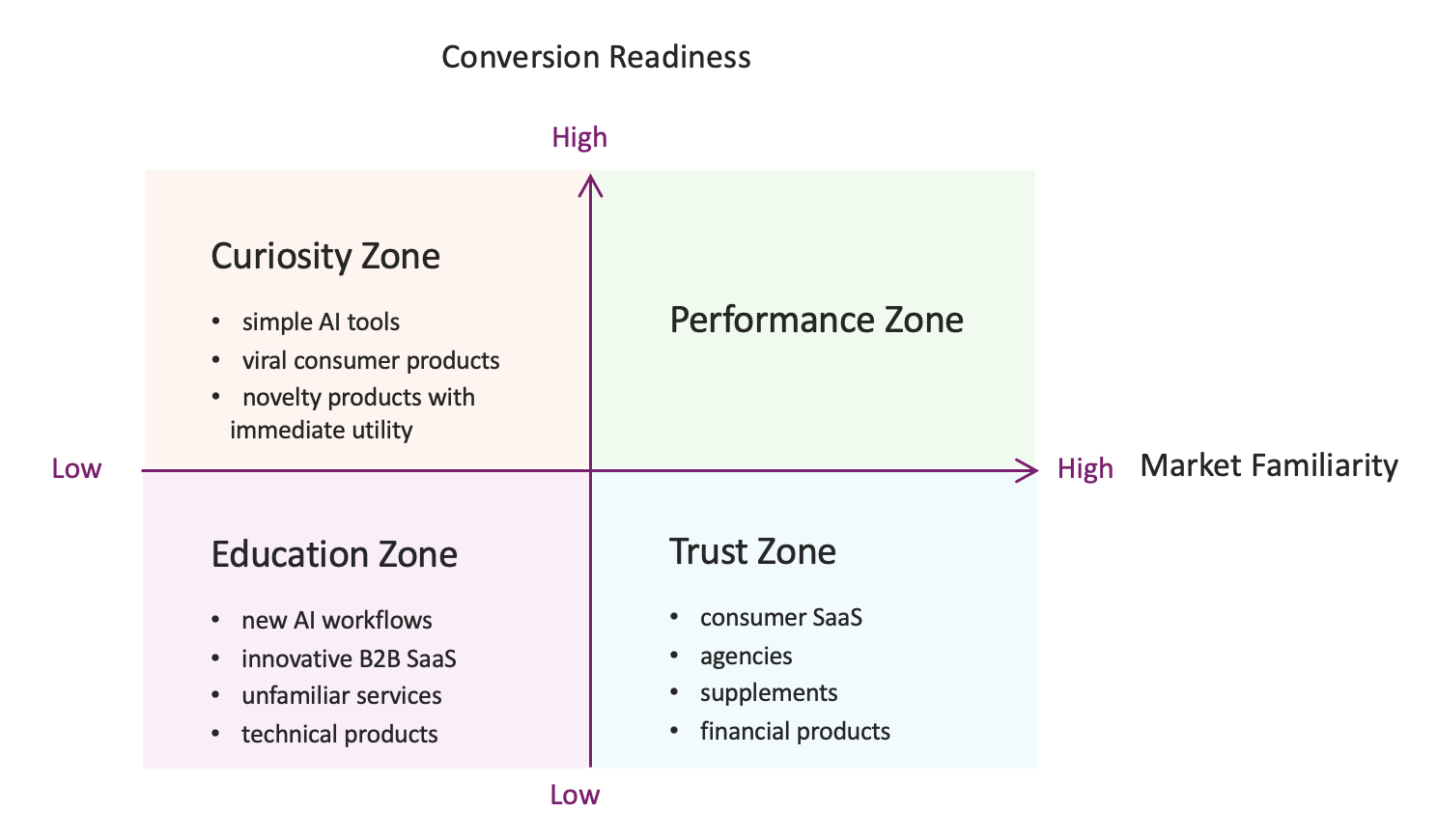
Market Familiarity
How quickly can people understand the problem you try to solve, which category you are, and the value you bring.
Conversion Readiness
How naturally can people decide to buy? Thinking about trust, urgency, perceived risk, price sensitivity, immediacy of value, etc.
When you combine these two dimensions, you get four very different marketing situations.
1. The Education Zone
This is where many innovative startups quietly struggle.
People may not understand the problem, or even the category itself (eg. "what is marketing decision intelligence").
Here, before they start to trust the product, they might not even know why they should care at all.
At this stage, aggressive conversion marketing often feels inefficient because the audience still needs context and education.
The problem is not necessarily the campaign itself.
The problem is asking cold audiences to make warm decisions.
And honestly, I think many founders underestimate how expensive explanation itself is.
2. The Trust Zone
Here, people already understand the category.
They know what the product is. They may even actively search for solutions.
But they still hesitate to buy from you.
The friction here is usually trust.
Credibility, proof, differentiation, reputation, perceived safety.
At this stage, marketing becomes less about explanation and more about reducing uncertainty.
3. The Curiosity Zone
This is an interesting one.
People may not fully understand the category yet, but the value feels immediately obvious.
These products can sometimes grow quickly because curiosity and immediate value compress parts of the funnel.
But I also think many founders mistakenly assume they are in this quadrant when they are not.
4. The Performance Zone
This is where performance marketing becomes much more efficient.
People already understand the problem, understand the category. They trust the buying behavior and actively look for solutions.
Now marketing becomes more about positioning, efficiency, optimization, timing and distribution.
Ironically, this is the stage many teams think they are already in.
But often they are still fighting awareness or trust problems underneath.
The Questions That Reveal Hidden Friction
It's crucial to position yourself correctly.
But it's confusing as well.
That's why I prepared these questions.
They are here not to rigidly label your business into one funnel stage, but to uncover the frictions slowing your marketing.
Ask yourself:
- Are you offering something innovative?
- Is your brand new?
- Is your product/service comparable to existing ones?
- Is your product/service part of daily behavior?
- Can someone understand your product/service within 5 seconds?
- Does it provide immediate value?
- Does the customer already know they have this problem?
- How expensive is the mistake of buying the wrong product?
Each question reveals a different type of friction:
- Awareness friction (Q1, Q7)
- Understanding friction (Q1, Q3, Q5)
- Trust friction (Q2)
- Behavioral friction (Q4)
- Value friction (Q6, Q8)
And the more friction exists, the harder it becomes to force immediate conversion.
So, answer these questions honestly, and you will figure our which friction you need to resolve at first.
Marketing Is About Moving People One Step Forward
We tend to ask the market for a type of decision it wasn't ready to make yet.
Because marketing does not always need to move people from strangers to loyal customers immediately.
Sometimes it only needs to move them one step forward.
From:
- Unaware -> curious
- Curious -> interested
- Interested -> trusting
- Trusting -> buying
Trying to force multiple transitions at once often creates expensive marketing.
Especially for smaller teams with limited resources.
This framework is not meant to replace advanced marketing strategy.
It's simply the structure I wish I understood earlier.
Because before asking "which channel should we use", it may be more important to ask:
"What friction are we actually trying to reduce right now?"
Sometimes marketing problems are not caused by lack of effort.
Sometimes they come from trying to solve the wrong stage first.
Get a free campaign check
We’ll review your campaign, surface misalignments, and share practical opportunities to improve performance.