
Overview
Within the OneLence Signal-to-Decision Framework, the Decisions page represents the execution readiness layer.
After signals have formed, sources have been evaluated, and strategic meaning has been clarified, this area helps transform that understanding into structured operational direction.
The goal of this page is not to manage campaigns directly. It is to help you understand what deserves focus, patience, or reduction based on current signal confidence and performance evolution.
Classifying Sources By Action Readiness
At the core of the Decisions page is the classification of performance sources into Scale, Hold, or Stop categories.
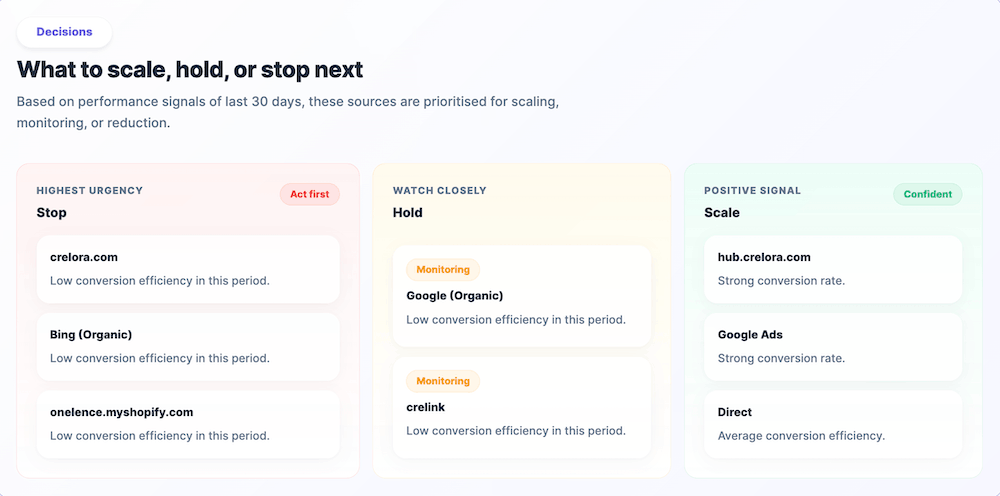
This classification reflects how reliable and growth-supportive each signal environment currently appears.
- Scale indicates that behavioural consistency and performance contribution are strong enough to justify increased investment or exposure.
- Hold suggests that signals are present but still developing, requiring continued observation before strategic expansion.
- Stop highlights environments where signal strength or quality is currently insufficient to support further resource allocation.
📌 Rather than reacting to short-term fluctuations, this structured grouping helps teams apply confidence-based prioritisation when allocating marketing effort.
Understanding Urgency And Monitoring Layers
Not all signals require the same response speed.
The Decisions page therefore introduces a layered view of operational urgency, helping you distinguish between immediate risks and longer-term observation needs.
For example, sources placed under higher urgency typically show:
- weak directional contribution
- limited behavioural depth
- or unstable performance consistency
Meanwhile, monitoring categories indicate that performance movement is still forming and should be evaluated over additional activity cycles.
📌 This staged perspective encourages disciplined response timing, reducing the likelihood of premature scaling or unnecessary optimisation changes.
Tracking What Has Changed Over Time
Another important function of this page is to show recent shifts in signal quality and contribution.
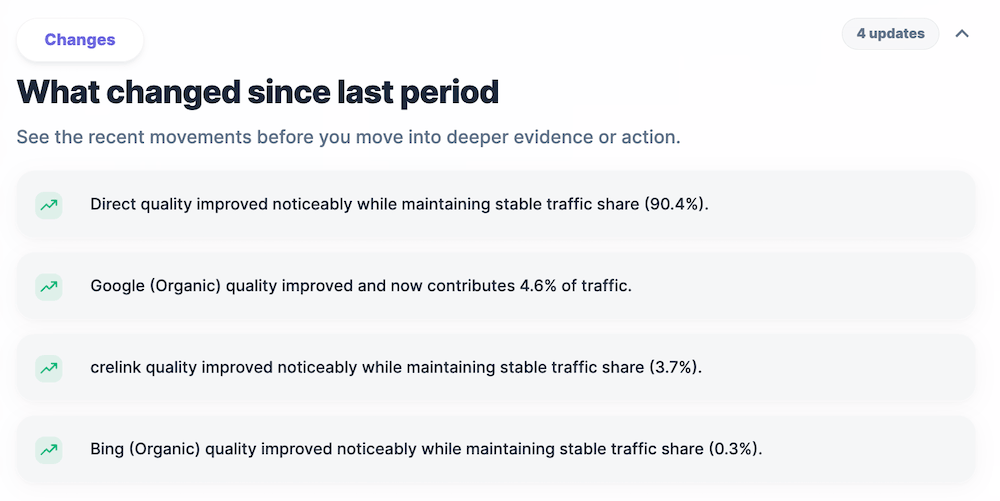
By highlighting what has improved, stabilised, or weakened since the previous evaluation period, OneLence supports a more dynamic understanding of growth progress.
This change-focused view helps you:
- recognise early improvement patterns
- detect weakening engagement environments
- validate whether past strategic adjustments are influencing outcomes
- maintain continuity between observation and action cycles
Seeing performance as movement rather than snapshot strengthens long-term decision accuracy.
Translating Insights Into Prioritised Actions
The Decisions page also introduces structured follow-up actions based on the interpreted signal environment.
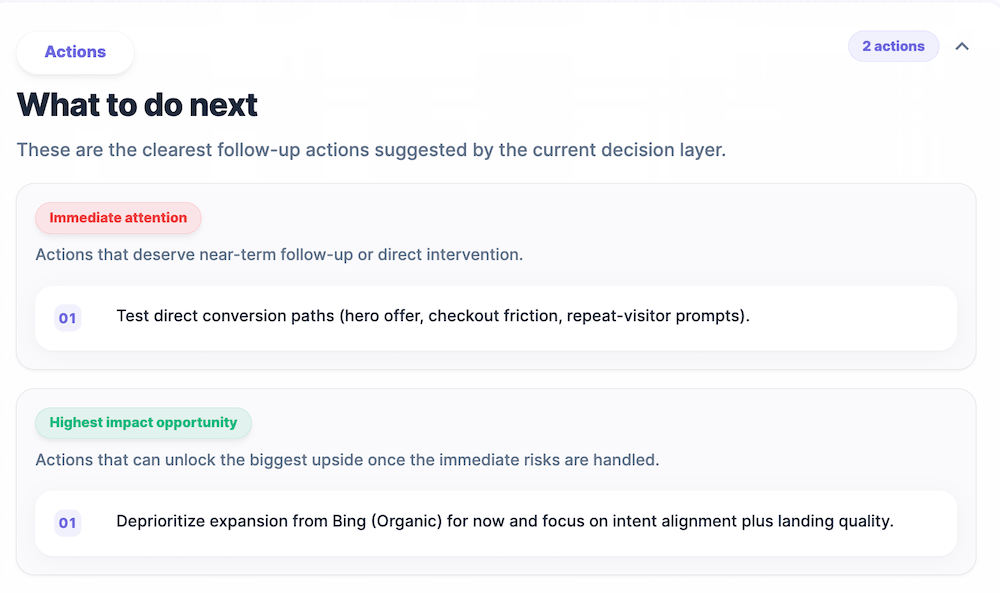
These actions are organised by their expected timing and impact level.
Typical distinctions include:
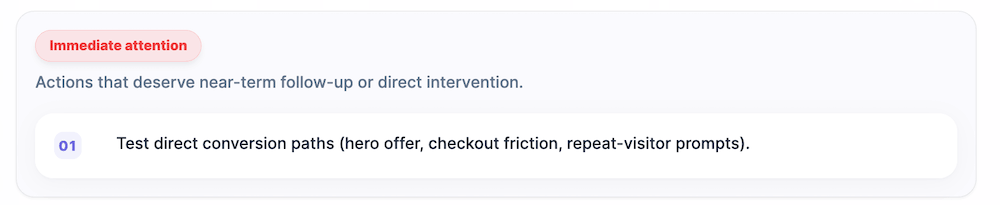
- Immediate attention areas, where performance friction or missed opportunity suggests near-term intervention
- Highest impact opportunities, where stronger signal potential indicates meaningful upside if conditions improve
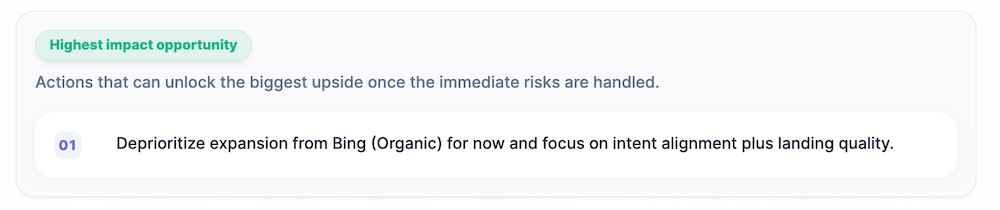
📌 This layered translation ensures that teams do not only understand growth dynamics conceptually, but can also begin to sequence practical next steps with greater clarity.
Exploring Forward-Looking Strategic Plays
Beyond current optimisation needs, OneLence also supports the exploration of future growth bets through strategic play generation.
This capability encourages teams to:
- test new positioning directions grounded in existing signal behaviour
- explore additional acquisition environments
- refine conversion pathways based on emerging performance tendencies
📌 By framing experimentation as a structured extension of signal interpretation, the Decisions page reinforces the idea that growth development is iterative and evidence-guided.
Validating Decisions Through Supporting Evidence
To strengthen confidence in prioritisation outcomes, the Decisions area provides access to supporting performance evidence.
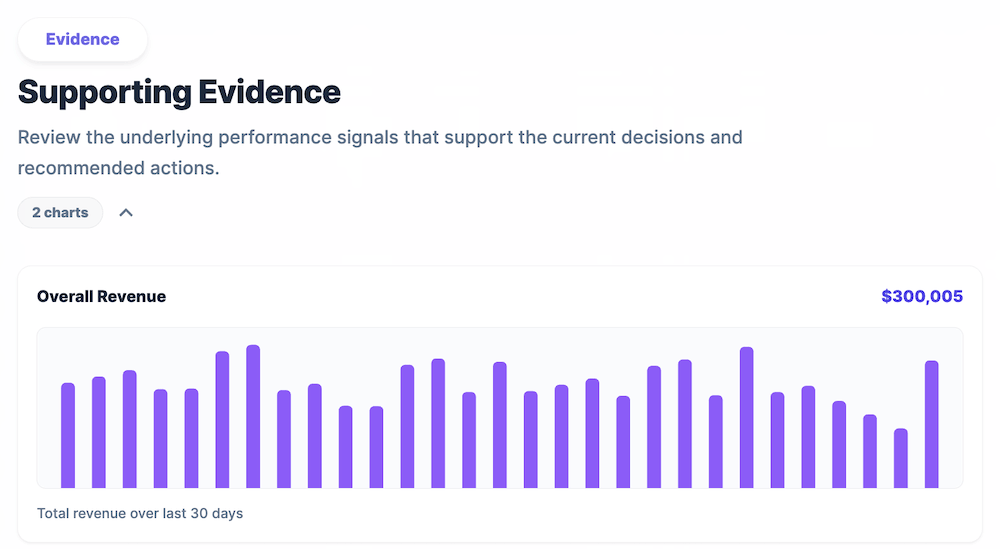
Underlying charts and signal visualisations allow you to review:
- the behavioural patterns informing current classifications
- performance trajectories across recent evaluation periods
- the signal density supporting recommended actions
📌 This transparency helps teams move from passive acceptance to informed execution confidence, ensuring that growth decisions remain anchored in observable performance conditions.
Using The Decisions Page In Your Workflow
In practice, the Decisions page functions as the final alignment checkpoint before operational action.
Regular review of this area helps teams:
- focus resources on environments with credible growth potential
- maintain patience where signal clarity is still developing
- reduce exposure to underperforming acquisition conditions
- build structured experimentation plans grounded in real activity patterns
By translating interpreted growth reality into clear prioritisation logic, this layer helps organisations act with greater discipline and strategic coherence.
The next section explores how real-time behavioural validation supports this framework through the Live monitoring area.