
Marketing performance rarely becomes fully clear at once.
Traffic behaviour, engagement quality, and conversion outcomes typically evolve as campaigns generate sustained interaction over time.
To interpret this process more realistically, this guide introduces a simple conceptual progression that explains how performance understanding develops step by step.
The Signal-to-Decision Framework
In practical growth environments, meaningful action usually emerges through a sequence of interpretive stages:
- Data shows activity.
- Signals reveal repeated movement.
- Insights explain what the movement means.
- Decisions determine how to respond.
This progression is referred to throughout this guide as the Signal-to-Decision Framework.
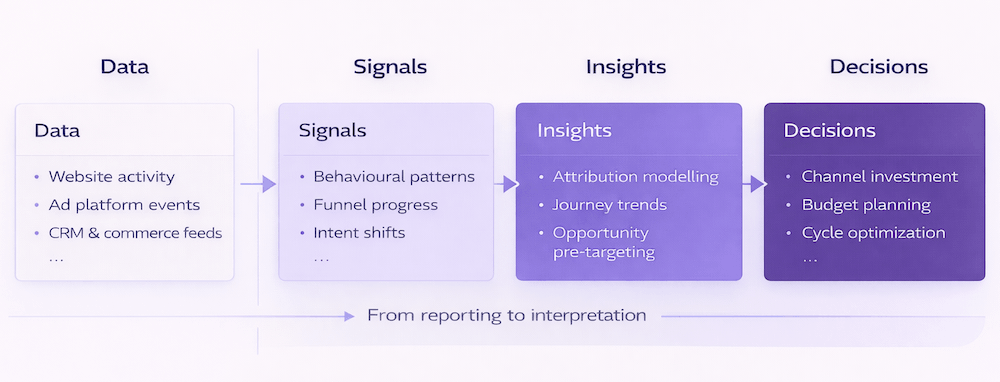 It forms the conceptual foundation for how structured growth evaluation should work in complex marketing environments.
Each stage depends on the strength of the previous one.
- Raw data provides evidence of user behaviour and campaign exposure.
- When behaviours repeat under similar conditions, they form signals.
- When signals are interpreted within context, they generate insights about performance direction.
- When insights reach sufficient clarity and confidence, they enable disciplined decision-making.
Understanding this progression helps teams move beyond reacting to isolated metrics and instead develop a more consistent view of how growth momentum actually forms.
What You Will Learn In This Chapter
The following sections explore each stage of the framework in detail.
- Signals vs Metrics explains why static numbers rarely reveal directional change.
- Growth Signals explores how behavioural tendencies form and how confidence builds over time.
- Growth Insights examines how signals gain meaning through contextual interpretation.
- Decision Readiness explains how organisations translate understanding into proportionate action.
Together, these principles create a structured foundation for evaluating marketing performance and preparing confident growth decisions in dynamic environments.