
After learning how growth signals form and evolve, the next step is understanding how these signals become meaningful interpretations.
Signals alone indicate movement. Insights transform that movement into structured understanding that can guide strategy.
Signals Alone Do Not Explain Growth
Seeing activity in your marketing environment does not automatically mean you understand it.
For example, you may notice:
- traffic increasing while revenue remains unchanged
- conversion events appearing but not stabilising
- engagement growing in some channels while others weaken
- funnel progression improving at early stages but stalling later
These situations generate signals, but not yet insight.
Signals describe behavioural change.
Insights explain the underlying growth dynamics shaping that change.
Learning to distinguish between these two levels of understanding is essential for interpreting performance realistically.
Context Turns Signals Into Meaning
A signal only becomes meaningful when it is evaluated within the right context.
The same behavioural movement can indicate opportunity, risk, or simple noise depending on surrounding conditions.
Important contextual dimensions include:
- Funnel position: early-stage engagement differs from late-stage conversion intent
- Source quality: not all traffic contributes equally to sustainable growth
- Behavioural consistency: repeated patterns carry more weight than isolated spikes
- Timing relationships: delayed effects often shape perceived performance
- Scale versus efficiency: growth volume may increase while effectiveness declines
Insight therefore emerges when signals are interpreted through relational understanding, not isolated observation.
In practice, this means asking not only what changed, but also how that change interacts with the broader growth environment.
Interactions Between Signals Create Insight Layers
Growth rarely shifts because of a single behavioural trend. More often, multiple signals interact simultaneously.
These interactions can form layered interpretations, such as:
- Momentum signals indicating strengthening performance direction
- Constraint signals revealing friction within acquisition or conversion paths
- Emerging opportunity signals suggesting new areas worth exploration
- Structural risk signals pointing to instability beneath short-term gains
For instance, increased traffic combined with declining conversion depth may indicate scaling pressure rather than healthy expansion.
Conversely, stable engagement combined with gradual funnel improvement may signal early-stage growth consolidation.
Understanding insight layers helps teams avoid simplistic conclusions and instead develop multi-dimensional growth awareness.
Insight Timing Matters As Much As Insight Accuracy
Even accurate interpretations lose strategic value if they arrive too late. Similarly, insights formed too early may lead to premature reactions.
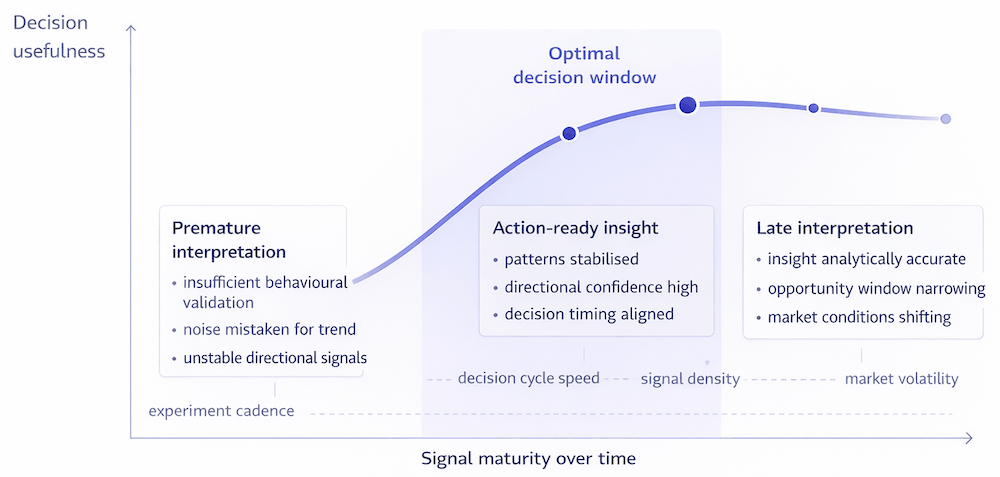
Insight usefulness depends on the balance between:
- Signal maturity: whether patterns have stabilised sufficiently
- Decision cycles: how quickly the organisation can act on new understanding
- Experiment cadence: the speed at which hypotheses can be validated
- Market volatility: the likelihood that conditions will shift unexpectedly
Effective growth management requires recognising when an insight is action-ready, not just theoretically correct.
This introduces a critical strategic dimension: insight quality is shaped not only by analytical clarity, but also by timing relevance.
Human Interpretation Has Cognitive Limits
As marketing environments expand, interpreting signals and generating reliable insights becomes increasingly complex.
Teams must navigate:
- overlapping acquisition channels
- evolving creator ecosystems
- multi-stage user journeys
- attribution ambiguity
- fluctuating campaign exposure
At the same time, human judgement is influenced by:
- recency bias toward recent performance spikes
- confirmation bias reinforcing existing assumptions
- dashboard overload reducing interpretive focus
- fragmented data views across tools
These challenges make consistent insight generation difficult even for experienced growth professionals.
Recognising these cognitive and structural limits is an important step toward more systematic growth intelligence.
Toward Structured Insight Frameworks
Modern growth organisations increasingly rely on structured frameworks to transform signals into actionable understanding.
Such frameworks aim to:
- consolidate behavioural evidence across multiple sources
- organise interpretations into clear thematic insights
- reduce ambiguity in performance evaluation
- support more confident and timely strategic adjustments
In the next chapter, you will explore how OneLence applies these principles by translating evolving signals into structured insight summaries and decision guidance designed to support real-world growth workflows.