
After signals have been interpreted into insights, the next challenge is transforming that understanding into effective action.
Many organisations reach a stage where performance patterns are visible, yet decision-making remains uncertain or delayed.
Developing decision readiness means aligning insight clarity, signal confidence, and execution timing in a structured way.
Insight Does Not Automatically Lead To Action
Recognising growth dynamics does not always result in immediate strategic movement.
Teams may observe meaningful developments such as:
- improving engagement quality
- stabilising acquisition sources
- emerging conversion behaviour
- changing funnel performance
However, hesitation often follows.
Common reasons include:
- uncertainty about whether signals are strong enough
- concern about scaling too early
- difficulty prioritising among multiple opportunities
- conflicting interpretations within the team
Insight creates awareness.
Decision readiness requires commitment under uncertainty.
Understanding this distinction helps organisations move beyond passive observation toward purposeful growth management.
Decision Intensity Should Match Signal Confidence
Not all signals justify the same level of response.
Effective growth decisions are typically graduated rather than binary.
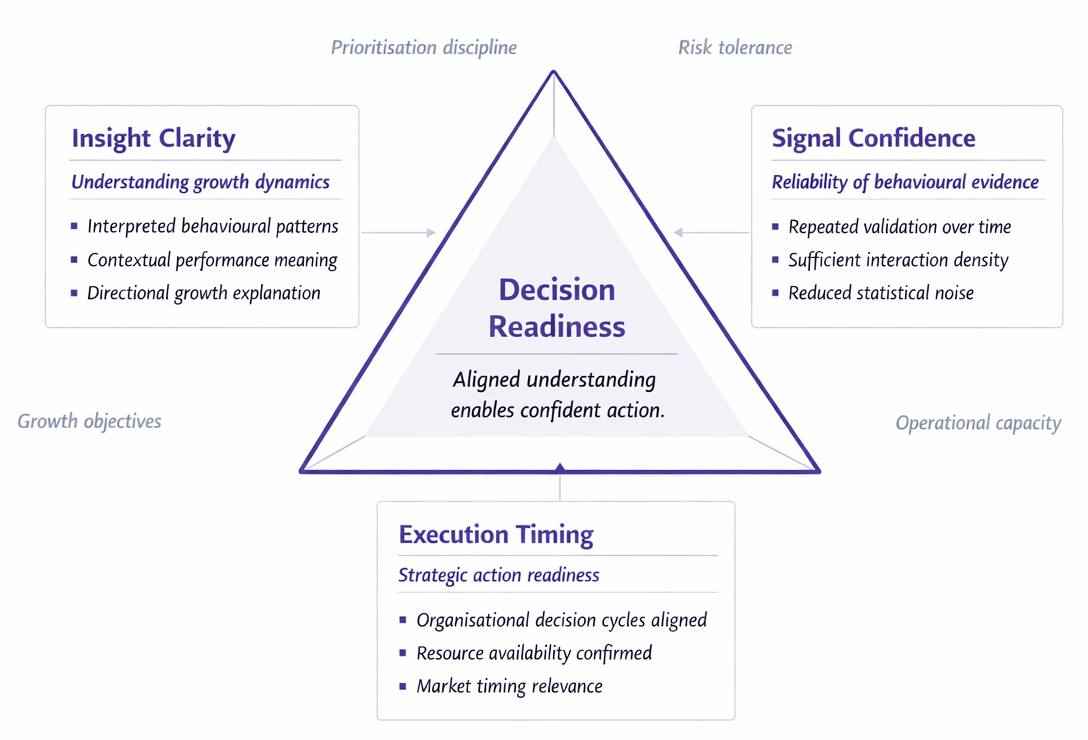
For example:
- weak or early signals may call for continued observation
- emerging signals may justify controlled experimentation
- stable signals may support scaling initiatives
- deteriorating signals may require corrective intervention
Matching action intensity to signal maturity reduces the risk of overreaction while preserving strategic agility.
This approach allows organisations to build momentum progressively rather than relying on abrupt directional shifts.
Prioritisation Shapes Growth Outcomes
Growth environments rarely lack opportunities.
Instead, they present an abundance of possible actions competing for limited resources.
Decision readiness therefore depends heavily on structured prioritisation.
Factors that often influence prioritisation quality include:
- expected impact on key growth objectives
- signal reliability based on observed behavioural consistency
- execution cost in terms of time, budget, or operational focus
- timing urgency related to market dynamics or campaign cycles
Choosing what not to pursue can be as important as deciding what to scale.
Organisations that apply disciplined prioritisation frameworks are better positioned to allocate resources where signal-backed potential is strongest.
The Risk Of Reactive Growth Management
Without structured decision logic, teams may fall into reactive patterns driven by short-term metric fluctuations.
This can lead to:
- prematurely scaling unstable acquisition channels
- abandoning initiatives that require longer validation periods
- misinterpreting temporary performance spikes as sustainable growth
- fragmenting strategic focus across too many experiments
Reactive management increases volatility and reduces organisational learning efficiency.
Sustainable growth requires recognising that not every signal demands immediate action, and that decision timing is itself a strategic variable.
Decision Frameworks Reduce Strategic Noise
As marketing ecosystems become more complex, decision-making benefits from consistent interpretive frameworks.
Such frameworks help organisations:
- align signal interpretation with action timing
- maintain coherence across teams and growth cycles
- reduce emotionally driven or anecdotal decisions
- improve the repeatability of successful strategic responses
Decision readiness thus evolves from an individual analytical skill into a systemic organisational capability.
Over time, structured decision processes can enhance both performance clarity and execution confidence.
Preparing For Structured Decision Intelligence
In increasingly multi-channel growth environments, translating insights into timely and proportionate actions becomes progressively more demanding.
Modern growth systems therefore aim to support decision readiness by:
- continuously synthesising evolving performance signals
- structuring insights into prioritised action contexts
- enabling more consistent responses to emerging opportunities and risks
In the next chapter, you will explore how OneLence operationalises these principles by transforming signal interpretation into structured insight summaries and decision guidance designed for real-world growth workflows.