
Overview
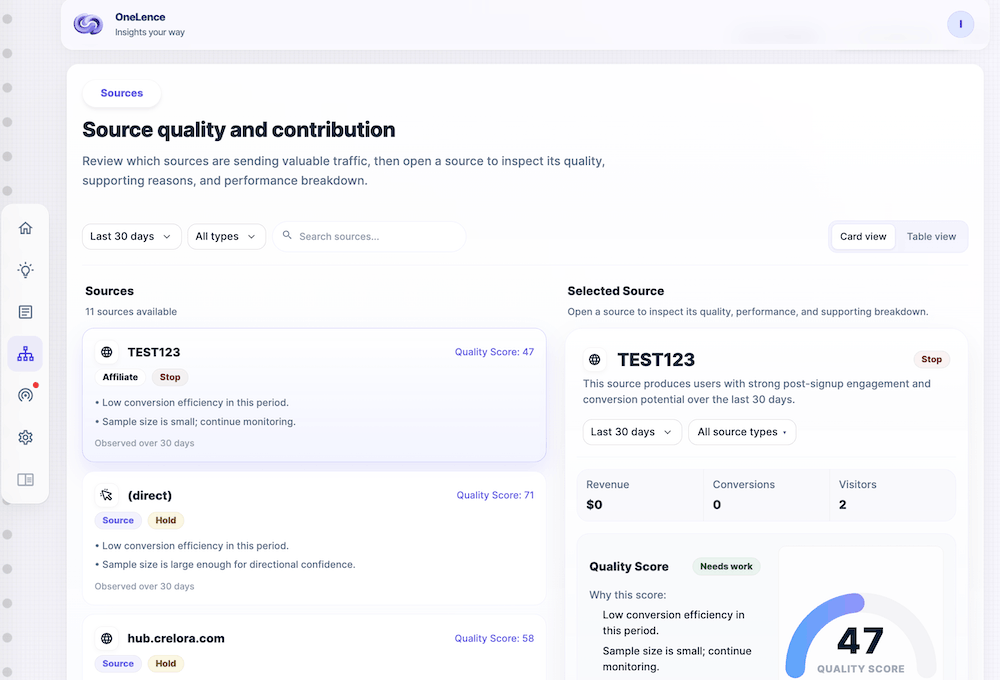 After recognising baseline movement on the Overview page, the next step in the OneLence framework is to understand where growth signals actually originate.
The Sources area translates scattered acquisition activity into structured signal interpretation.
Instead of simply listing traffic channels or campaigns, it evaluates how each source contributes to emerging performance direction.
At this stage, the goal is not optimisation.
It is to develop contextual awareness of signal quality, reliability, and contribution strength.
Reading Signal Quality At Source Level
Growth signals do not form uniformly across all acquisition inputs. Some sources generate meaningful behavioural momentum, while others introduce noise or unstable patterns.
The Sources view helps you recognise:
- which acquisition inputs generate consistent behavioural engagement
- where interaction density is sufficient to support directional interpretation
- whether signal formation is strengthening, stabilising, or weakening
- how different traffic origins contribute to overall growth clarity
This allows you to move from a general growth baseline toward origin-level signal understanding.
Understanding The Quality Score
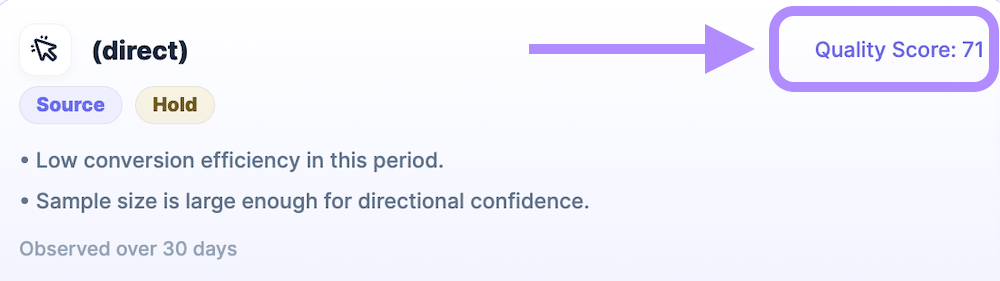
Each source is evaluated through a Quality Score, which reflects how convincingly that source contributes to meaningful growth signals.
This score represents a synthesis of:
- behavioural efficiency (such as conversion tendency or post-visit engagement)
- statistical confidence based on sample size and observation period
- consistency of performance patterns over time
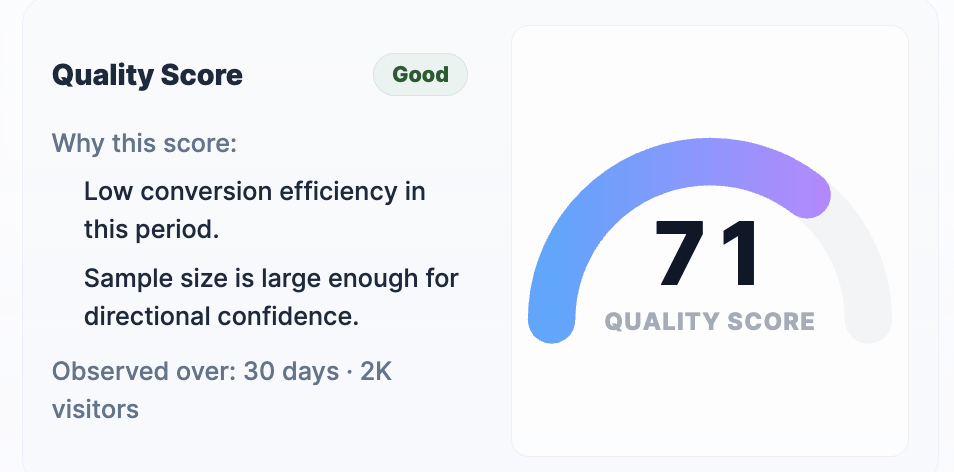 📌 Rather than acting as a performance grade, the Quality Score should be read as a signal reliability indicator.
Higher scores typically suggest:
- clearer behavioural direction
- stronger pattern repeatability
- increasing interpretability of future performance
Lower scores often indicate:
- unstable interaction patterns
- insufficient signal density
- early-stage or weakening momentum
Understanding this distinction helps prevent premature scaling or unnecessary channel abandonment.
Interpreting Directional Status (Scale · Hold · Stop)
Alongside the Quality Score, each source is assigned a directional signal status.
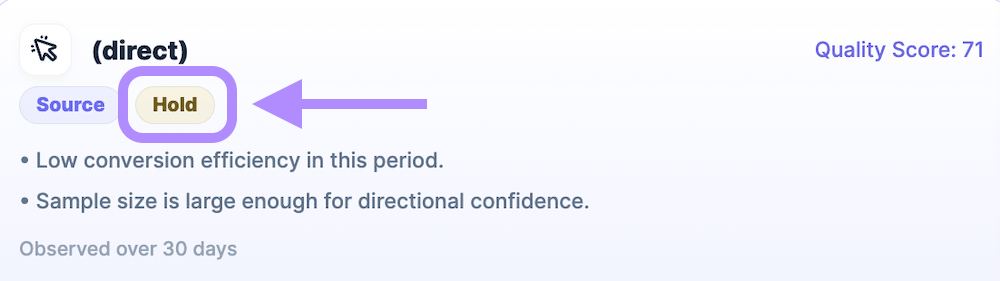
This status reflects how the system currently interprets the source’s role in overall growth development.
- Scale suggests signal strength is structurally improving
- Hold indicates signals exist but require further observation
- Stop signals weakening clarity or limited growth contribution
📌 At this stage in the framework, these labels should be understood as signal interpretation markers, not immediate execution commands.
They provide early directional context that becomes fully actionable later within the Decisions area.
Understanding Key Signal Takeaways
For each source, OneLence provides concise explanatory statements describing
why signal quality is interpreted in a certain way.
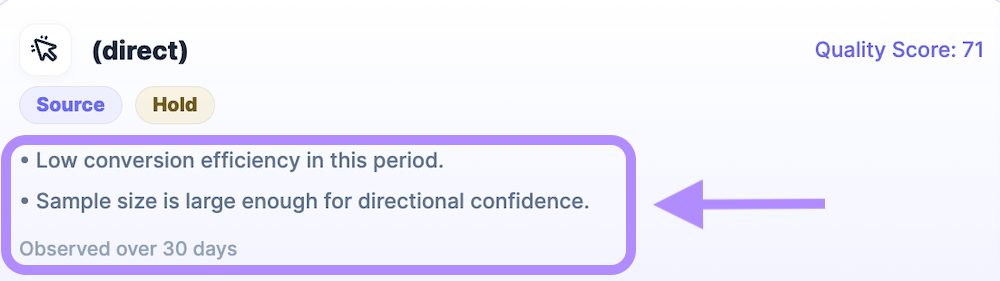
These takeaways often reference factors such as:
- conversion efficiency relative to traffic volume
- adequacy of the statistical observation window
- behavioural consistency within the selected time period
This transparency helps users develop interpretative confidence.
📌 Instead of relying on isolated metrics, you learn to evaluate how signal credibility evolves through accumulated activity.
Inspecting Source-Level Impact
Opening an individual source reveals its measurable contribution to growth formation within the selected evaluation window.
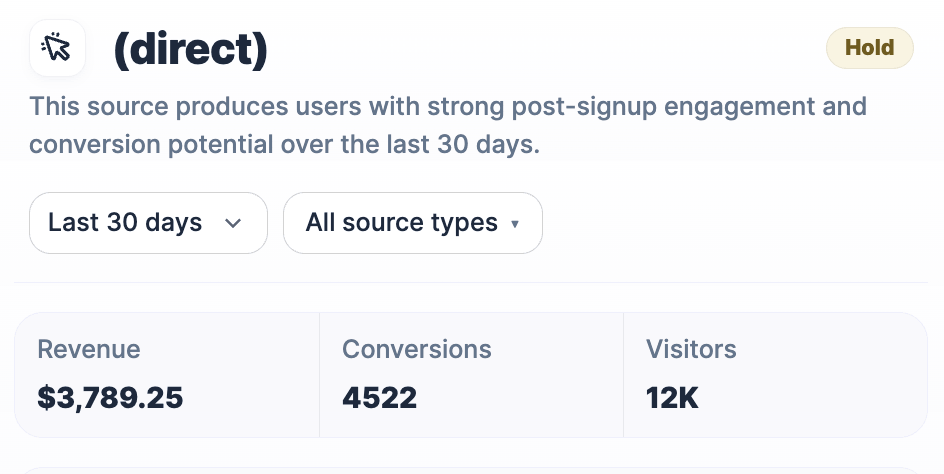
Here, signal impact is grounded in three core behavioural components:
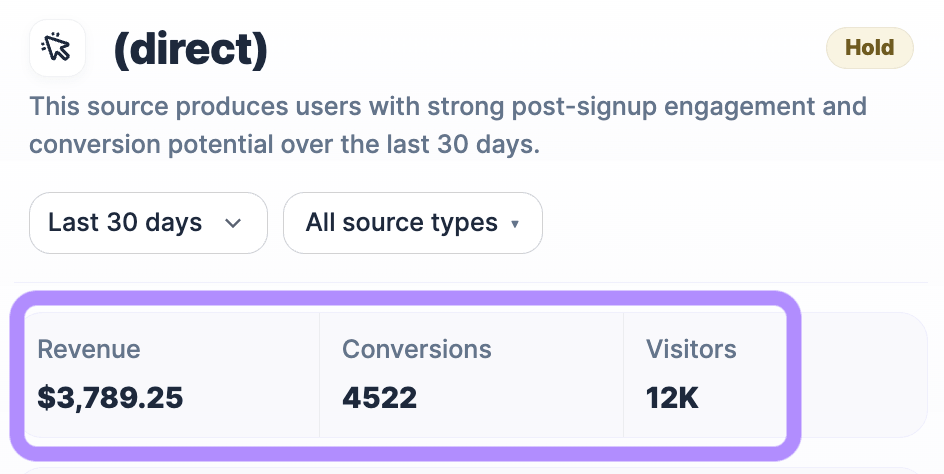
- visitor volume influenced by the source
- conversion activity generated during the period
- revenue movement associated with those interactions
📌 This layered view enables you to understand whether a source contributes surface-level traffic visibility or deeper behavioural progression.
Over time, repeated observation of these relationships helps you recognise which acquisition inputs genuinely support scalable growth conditions.
Positioning Sources Within The Framework
Within the broader Signal-to-Decision journey, the Sources area represents the transition from baseline awareness to structural signal diagnosis.
By learning to interpret signal quality at origin level, you prepare for:
- deeper behavioural interpretation in the Insights area
- clearer prioritisation logic in the Decisions layer
- more confident strategic experimentation in later growth cycles
Developing this interpretative habit ensures that future actions are grounded not in isolated performance spikes, but in observable and statistically supported growth momentum.
In the next section, you will explore how OneLence transforms source-level signal understanding into structured behavioural insights.