
Hyros is an AI-powered ad tracking and attribution platform founded by Alex Becker. Its patented print-tracking technology identifies users permanently across devices, recovering conversions that standard pixels miss, and it can display attribution data directly inside Facebook and Google Ads interfaces. Its customer base skews toward info-products, coaching, agencies, and high-ticket e-commerce: businesses where a single sale is worth a lot and every conversion matters.
Quick comparison
| OneLence | Hyros | |
|---|---|---|
| Category | Marketing decision layer | Ad tracking & attribution precision tool |
| Core output | Scale / hold / stop / review / watch decisions | Precise per-click ad source attribution |
| Source coverage | Paid, affiliate, creator, referral, organic | Primarily paid ads (Meta, Google, TikTok, YouTube) plus calls/email |
| Pricing | Flat plans from $49/mo, public | Revenue-based public pricing starts around $230/mo; custom setup required |
| Setup focus | Review workflow and decision discipline | Tracking-script implementation across funnels |
| Best fit | Small teams deciding across all sources | High-ticket paid-funnel operators |
What Hyros does well
- Tracking accuracy. Print tracking captures significantly more conversions than pixels alone and survives iOS privacy changes and cookie loss.
- In-platform stats. Verified conversions feed back via Meta CAPI and Google Enhanced Conversions, and appear inside the ad managers themselves.
- High-ticket fit. Call tracking and long-horizon stitching suit complex, expensive funnels.
- Human support. Dedicated setup teams earn near-perfect Trustpilot scores.
Where teams hit friction
Pricing is revenue-based rather than flat, and more customized accounts still require a setup call. The learning curve is steep, implementation can take weeks in some cases, and the product is not designed for enterprise B2B marketing teams or non-paid-heavy stacks.
Where OneLence takes a different approach
Hyros answers "which ad produced this sale?" with unusual precision. OneLence answers "given everything we know, including affiliate, creator, referral, and organic signals, what should we do next?"
- All sources, not just ads. Creator partnerships, affiliates, referrals, and organic signals get equal analytical standing.
- Decisions with evidence. Every recommendation carries confidence level, supporting and missing evidence, and a next task.
- Timing discipline. OneLence flags signals that are too early or too weak to judge instead of over-trusting precise-looking numbers.
- Transparent, flat pricing from $49/month with a self-serve trial.
Who should choose which
- Choose Hyros if you run high-ticket paid funnels (coaching, info-products, premium DTC) where recovering every last conversion justifies premium, quote-based pricing.
- Choose OneLence if your challenge is not missing clicks but unclear decisions, if you need a repeatable way to weigh all your marketing sources and commit to scale/hold/stop calls each cycle.
A different kind of output
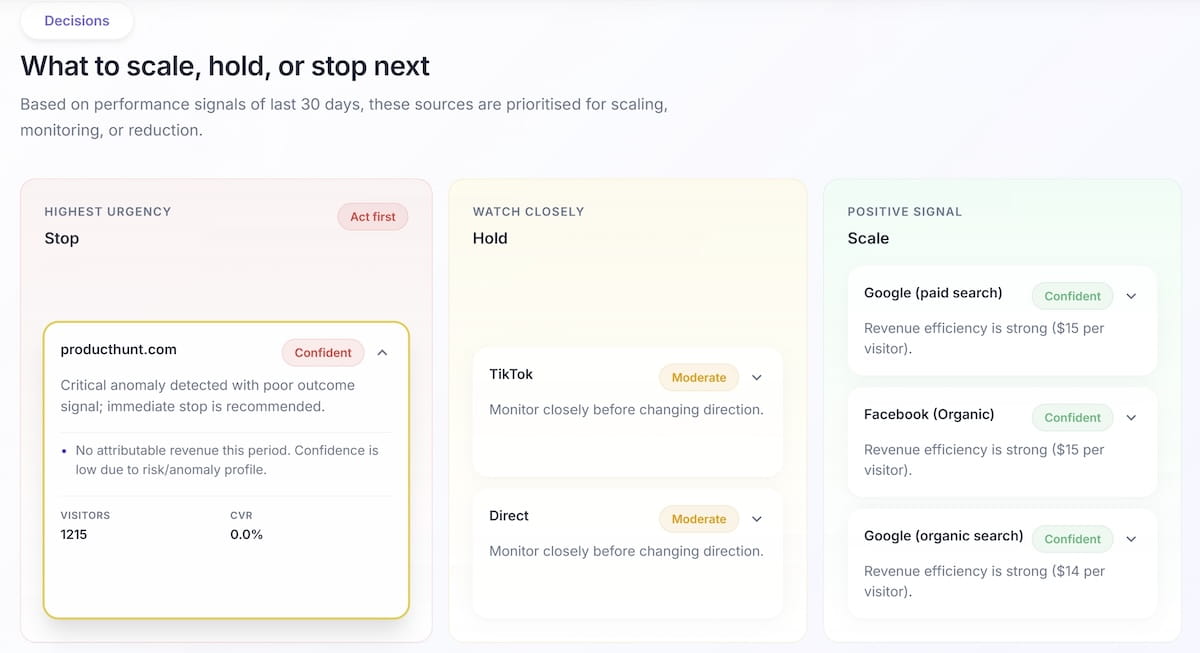
From performance signals to a clear next move
OneLence does not add another reporting dashboard. It weighs timing, context, and evidence strength, then makes the decision state explicit.
FAQ
Frequently asked questions
What is Hyros best known for?
Patented "print tracking" that stitches clicks, calls, email touches, and sales back to their ad source across devices, capturing more conversions than browser pixels alone. It is especially popular with info-product, coaching, and high-ticket direct-response businesses.
Is Hyros pricing transparent?
Hyros now publishes revenue-based pricing that starts around $230/month on an annual plan, while larger or more customized accounts still require a setup call. OneLence publishes flat monthly plans from $49/month with a 7-day free trial.
Does OneLence replace ad tracking?
OneLence includes consent-aware browser and server-side signal tracking across your sources, but its focus is not maximum-precision ad credit. It is the layer above tracking: weighing signals through context, timing, and evidence strength to produce decisions.
Make the next move clearer
Decide what to scale, hold, or stop
Review marketing signals through context, timing, and evidence strength, then turn them into an action your team can defend.