
Triple Whale started as a Shopify attribution pixel and grew into a broad ecommerce operating system: consolidated dashboards, creative analytics, cohort analysis, and its Moby AI assistant. It is one of the best-known names in DTC analytics, with a free plan and paid tiers that scale with annual GMV (12-month contracts are standard).
If you run a Shopify store and want everything in one dashboard, Triple Whale is a reasonable choice. This comparison focuses on a different question: which tool helps you decide where the next dollar goes?
Quick comparison
| OneLence | Triple Whale | |
|---|---|---|
| Category | Marketing decision layer | Ecommerce analytics & attribution suite |
| Core output | Scale / hold / stop / review / watch decisions with confidence and missing evidence | Dashboards, attribution reports, AI-generated insights (Moby) |
| Platform focus | Platform-agnostic: affiliate, paid, creator, referral, organic sources | Shopify-first ecosystem |
| Pricing model | Flat monthly plans from $49/mo, 7-day free trial | Free plan; paid tiers priced by annual GMV, typically on 12-month contracts |
| Attribution | Source-level signals reviewed through context, timing, and evidence strength | Proprietary Triple Pixel plus seven attribution models including survey-blended Total Impact |
| Best for | Small teams that must act despite incomplete data | Shopify brands that want deep pixel-level analytics |
What Triple Whale does well
- Deep Shopify integration. The Triple Pixel captures cross-device journeys inside the Shopify ecosystem better than generic pixels.
- Multiple attribution models. Seven models, including deterministic view data from major ad platforms and Total Impact, which blends multi-touch attribution with post-purchase surveys.
- Broad suite. Creative analytics, retention cohorts, BI dashboards, and Moby AI agents cover a lot of ground.
- Free entry point. A usable free plan makes it easy to evaluate.
Where teams hit friction
Reported criticisms center on pricing structure rather than capability: costs rise with GMV, which penalizes growth; advanced features sit behind higher tiers; add-ons accumulate. Some reviewers note the pixel's depth is limited outside Shopify environments, and that AI recommendations can be surface-level for nuanced budget calls.
Where OneLence takes a different approach
Triple Whale shows you what happened. The harder problem is deciding what to do about it, especially when signals conflict and data is incomplete. That is the gap OneLence fills:
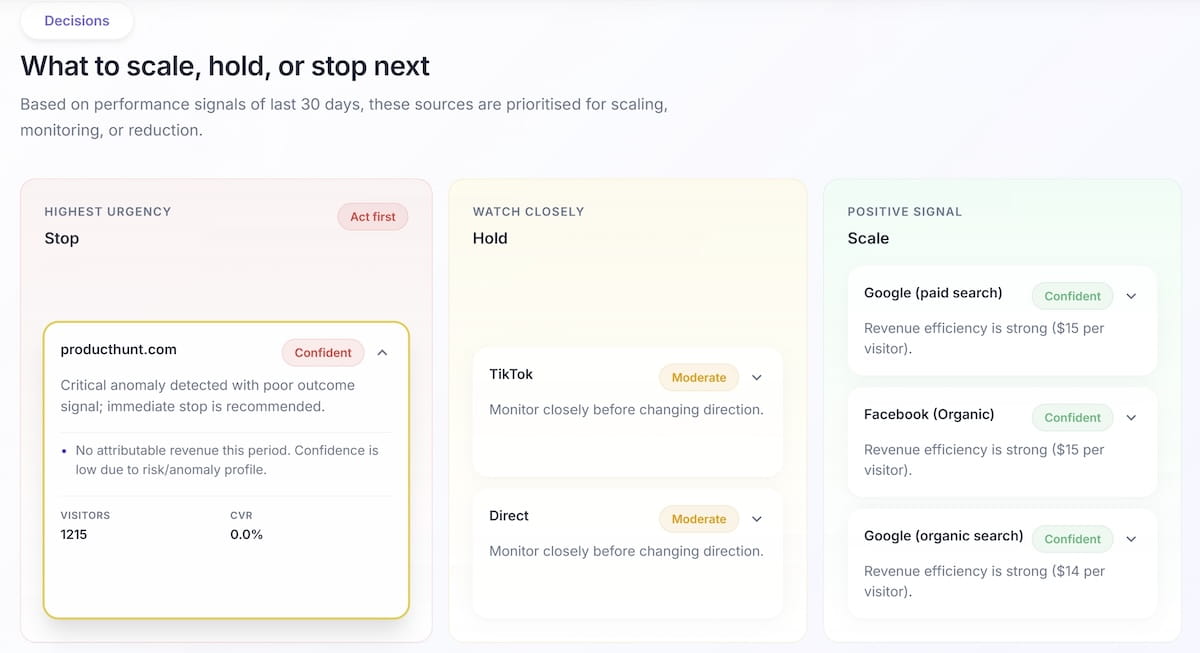
- Decisions, not just reports. Every review ends in one of five actions (scale, hold, stop, review, or watch longer), with a confidence level, the evidence behind it, and what is still missing.
- Timing discipline. OneLence explicitly tells you when a signal is too early or too weak to judge fairly, instead of nudging you to react to noise.
- Beyond Shopify. Affiliate programs, creator partnerships, referrals, and organic sources are first-class citizens, alongside paid channels.
- Predictable pricing. Plans from $49/month with no GMV-based jumps, so growing your revenue does not grow your analytics bill.
- Consent-aware tracking. Signals are observed at runtime but stored persistently only after consent, with pseudonymous visitor IDs.
Who should choose which
- Choose Triple Whale if you are a Shopify-native brand that wants pixel-level attribution, creative analytics, and an all-in-one dashboard, and GMV-based pricing fits your stage.
- Choose OneLence if you already have dashboards but decisions stall anyway, if your team argues about which numbers to trust and which campaigns deserve next month's budget. OneLence is also the stronger fit for mixed stacks (Shopify + Stripe + WordPress + affiliate networks) and for teams priced out of GMV-based tools.
They can coexist: many teams keep a measurement suite for reporting and add OneLence as the layer that converts those reports into decisions.
A different kind of output
From performance signals to a clear next move
OneLence does not add another reporting dashboard. It weighs timing, context, and evidence strength, then makes the decision state explicit.
FAQ
Frequently asked questions
Is OneLence a cheaper Triple Whale?
No, they are different categories of tool. Triple Whale is an ecommerce analytics and attribution suite built around Shopify data. OneLence is a marketing decision layer that sits above your existing tools and turns signals into prioritized decisions. Pricing differs structurally too: Triple Whale prices by annual GMV, while OneLence plans start at $49/month regardless of your revenue.
Can I use OneLence instead of Triple Whale?
You can, but they solve different problems. If you rely on Triple Whale's pixel-level ecommerce dashboards, you may want to keep them. OneLence replaces the part most teams actually struggle with: deciding which campaigns and sources deserve budget based on incomplete or conflicting signals.
Does OneLence work outside Shopify?
Yes. OneLence tracks affiliate, paid, creator, referral, and organic sources across your stack, with native integrations for Shopify, Stripe, and WordPress plus an SDK for custom setups. It is not tied to a single commerce platform.
Make the next move clearer
Decide what to scale, hold, or stop
Review marketing signals through context, timing, and evidence strength, then turn them into an action your team can defend.