
Google Analytics 4 is the default web analytics platform on the internet, free, deeply integrated with Google Ads, and installed almost everywhere. For basic traffic reporting it works. The problems start when teams try to use it for budget decisions.
Quick comparison
| OneLence | Google Analytics 4 | |
|---|---|---|
| Category | Marketing decision layer | General web/app analytics |
| Core output | Scale / hold / stop / review / watch decisions with confidence and evidence | Traffic, engagement, and conversion reports |
| Attribution | Source-level signals weighed through context, timing, and evidence strength | Data-driven attribution (black box) or last click only |
| Cookie/privacy loss | Consent-aware browser + server-side signals with pseudonymous IDs | Browser-cookie dependent; ad blockers and iOS ATT hide journeys |
| Sampling | Full review of tracked sources | Sampling and thresholds distort large explorations |
| Recommendations | Explicit decisions with next tasks | None, reports only |
Where GA4 falls short for decisions
These are well-documented limitations, not edge cases:
- Black-box attribution. Since 2023, GA4 offers only last click and data-driven attribution; you cannot inspect how credit is assigned, and results from non-Google ad platforms rarely match their own reporting.
- Sampling and thresholds. Detailed explorations above roughly ten million events get sampled, quietly skewing conversion paths.
- Signal loss. Ad blockers, browser privacy features, and Apple's App Tracking Transparency hide a meaningful share of orders and journeys, often misattributing view-heavy channels to Direct.
- No decision layer. GA4 will never tell you that a campaign should be stopped, held, or scaled; let alone how confident to be or what evidence is missing.
- Complexity. Event configuration and session logic are harder than Universal Analytics ever was, for analysts and marketers alike.
What OneLence adds
- Decisions instead of dashboards: every review ends in scale / hold / stop / review / watch longer, with confidence level, supporting evidence, and missing evidence.
- Timing honesty: OneLence tells you when a signal is too early to judge, something no analytics report expresses.
- Sources beyond web sessions: affiliate partners, creators, referrals, and other non-GA4-native signals are first-class inputs.
- Consent-aware architecture designed for the post-cookie reality GA4 struggles with.
Who should choose which
It is rarely either/or:
- Keep GA4 as your free baseline web analytics and Google Ads integration.
- Add OneLence when you are tired of exporting GA4 spreadsheets and arguing about what they mean, when you want a system that weighs all your marketing signals and outputs decisions your team can act on.
A different kind of output
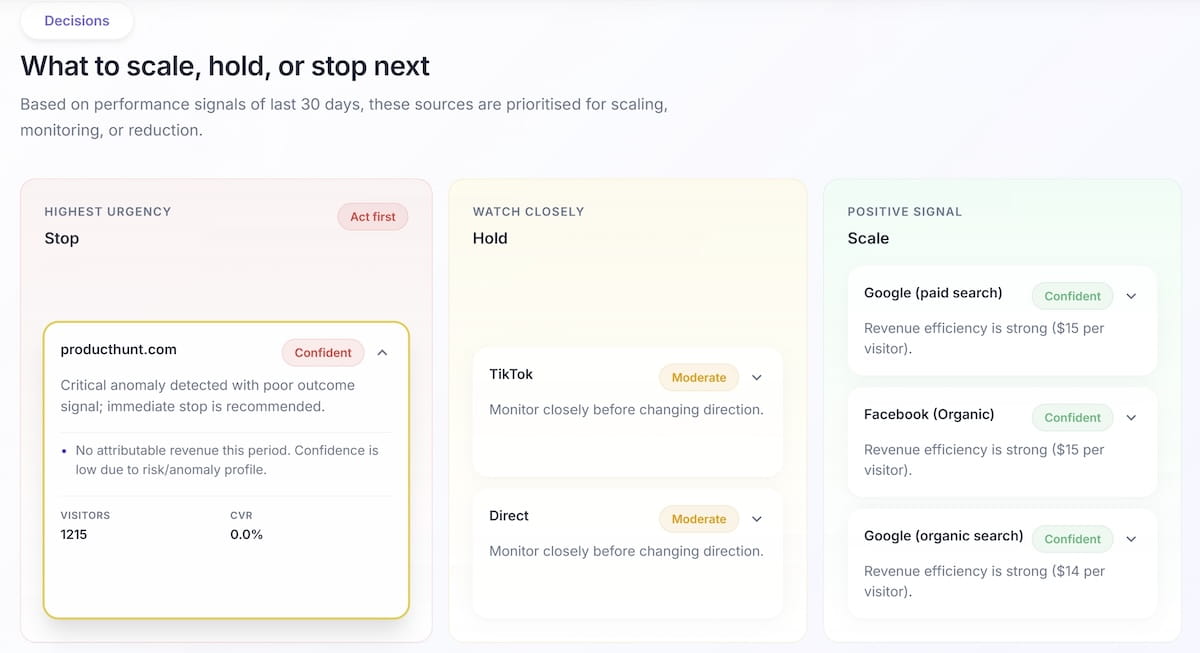
From performance signals to a clear next move
OneLence does not add another reporting dashboard. It weighs timing, context, and evidence strength, then makes the decision state explicit.
FAQ
Frequently asked questions
Is OneLence a replacement for GA4?
Not necessarily. GA4 remains a useful free source of web and app analytics, and its BigQuery export feeds many data stacks. OneLence operates as a decision layer above your analytics: it reviews source-level signals through context, timing, and evidence strength to produce actionable recommendations GA4 does not attempt.
Why doesn't GA4 tell me which campaigns to scale?
GA4 is a general-purpose analytics engine focused on collecting events and reporting them. Its data-driven attribution model is a black box, sampling distorts detailed explorations at scale, and it has no concept of confidence, timing maturity, or missing evidence: the ingredients of an actual recommendation.
Does OneLence work with my existing tracking?
Yes. OneLence provides consent-aware browser and server-side signal collection with native integrations for Shopify, Stripe, and WordPress plus an SDK. It complements rather than replaces your existing analytics.
Make the next move clearer
Decide what to scale, hold, or stop
Review marketing signals through context, timing, and evidence strength, then turn them into an action your team can defend.