
Littledata calls itself "the data layer for Shopify." Its job is precision plumbing: server-side tracking that recovers orders ad blockers and iOS privacy settings hide from browser pixels, then routes clean events to GA4, Meta, Klaviyo, and other destinations. Pricing is transparent and usage-based (Flex starts at $0.35 per tracked order, Scale starts around $159/month, and Plus starts around $792/month).
Quick comparison
| OneLence | Littledata | |
|---|---|---|
| Category | Marketing decision layer | Server-side tracking pipeline for Shopify |
| Core output | Scale / hold / stop / review / watch decisions | Accurate ecommerce events delivered to GA4/Meta/Klaviyo/etc. |
| Platform scope | Shopify, Stripe, WordPress, SDK, platform-agnostic | Shopify-centric |
| Source coverage | Paid, affiliate, creator, referral, organic | Ecommerce order/session events |
| Pricing | Flat plans from $49/mo | Per-order Flex pricing plus Scale and Plus plans; overages on spikes |
| Decision support | Confidence, evidence, timing discipline per decision | None, data infrastructure |
What Littledata does well
- Solves a real, painful problem: Shopify's checkout breaks standard pixels; Littledata's server-side approach restores accuracy.
- Transparent pricing relative to enterprise attribution suites.
- Strong subscription support (Recharge) and well-rated customer service.
Where teams hit friction
Per-order pricing surprises merchants during BFCM-style spikes; it is Shopify-only by design; and, crucially for this comparison, clean data still needs someone to interpret it.
Where OneLence takes a different approach
Littledata improves what goes into your reports. OneLence improves what comes out of them:
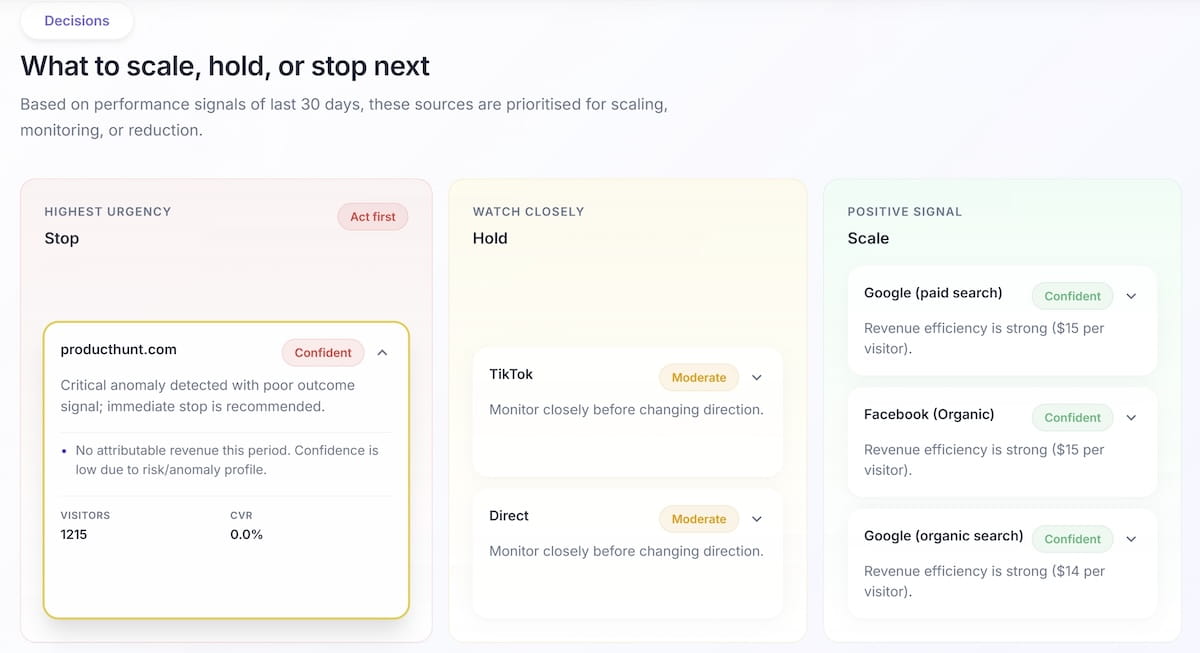
- Decision outputs: scale / hold / stop / review / watch longer, with confidence level, evidence, and missing evidence.
- Timing discipline: explicit "too early to judge" states instead of over-reacting to fresh noise.
- Beyond orders: affiliate, creator, referral, and organic source quality reviewed over time.
- Flat pricing from $49/month regardless of order volume.
Who should choose which
- Choose Littledata if your primary pain is broken Shopify→GA4/Meta tracking and you want a specialist pipe.
- Choose OneLence if your tracking is "good enough" but your weekly review is not: deciding which campaigns, partners, and sources deserve budget is the actual bottleneck.
Many stacks benefit from both: accurate signals flowing in, disciplined decisions coming out.
A different kind of output
From performance signals to a clear next move
OneLence does not add another reporting dashboard. It weighs timing, context, and evidence strength, then makes the decision state explicit.
FAQ
Frequently asked questions
What does Littledata actually do?
Littledata provides server-side tracking for Shopify stores, fixing the order- and session-level gaps that break standard pixel setups. It pipes accurate ecommerce events to GA4, Meta Conversions API, Google Ads Enhanced Conversions, Klaviyo, TikTok, Pinterest, and Segment. Pricing is usage-based per tracked order.
Can OneLence replace Littledata?
They overlap only partially. OneLence includes its own consent-aware browser and server-side signal collection with native Shopify, Stripe, and WordPress integrations, so you may not need a separate pipeline. But if you specifically need GA4/Meta event parity in Shopify checkout flows, Littledata remains a solid specialist.
Which is better for affiliate and creator programs?
Littledata focuses on ecommerce event delivery and has no native affiliate or creator review features. OneLence treats affiliate partners, creators, referrals, and organic sources as first-class signals with payout-aware review and decision outputs.
Make the next move clearer
Decide what to scale, hold, or stop
Review marketing signals through context, timing, and evidence strength, then turn them into an action your team can defend.