
Effective growth intelligence depends on the quality and continuity of the signals collected across your product and marketing surfaces.
Before implementing tracking code, it is important to understand how OneLence processes signals, how attribution is constructed, and how browser-level behaviour connects to verified business outcomes.
This chapter introduces the core signal architecture that underpins OneLence.
The Signal Lifecycle in OneLence
In OneLence, growth insights are not generated from isolated events.They emerge from the lifecycle of signals as users move from marketing touchpoints to meaningful product actions.
A typical signal lifecycle follows this progression:
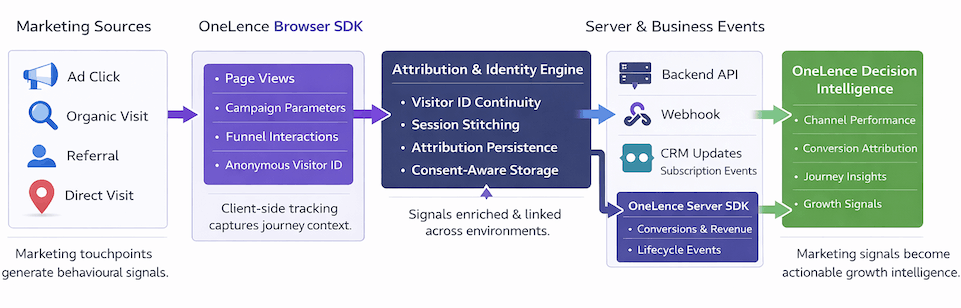
- Marketing interaction: A visitor arrives from a campaign, referral, organic search result, or direct navigation.
- Behavioural signal capture: The browser tracking layer records page views, funnel interactions, and attribution parameters such as campaign identifiers or click IDs.
- Signal enrichment and attribution persistence: Captured signals are associated with a pseudonymous visitor identity and enriched with contextual information such as session continuity, referrer relationships, and consent status.
- Business outcome confirmation: Backend systems generate reliable outcome events such as subscription activation, purchase confirmation, or lifecycle state changes.
- Insight formation: OneLence connects behavioural context with confirmed outcomes, allowing teams to understand which marketing sources and journeys influence real growth results.
This lifecycle ensures that insights are grounded in both journey context and verified conversions, rather than surface-level engagement metrics.