
Modern growth tracking architectures typically operate across two environments: the browser and the server.
Browser-Side Tracking
Browser-based tracking (client-side tracking) captures the exploratory and behavioural phase of the user journey.
This includes:
- landing page visits
- navigation paths
- campaign attribution parameters
- pre-conversion product interactions
- anonymous visitor identity continuity
Because these signals originate directly from user interactions, they provide essential context for understanding how demand is generated and how users progress through acquisition funnels.
However, browser signals alone may not provide reliable confirmation of business outcomes, particularly when key events occur outside the client runtime.
Server-Side Tracking
Server-side tracking complements behavioural data by capturing events that represent confirmed business state changes.
Examples include:
- successful payment processing
- subscription lifecycle transitions
- account provisioning completion
- webhook-triggered commerce events
These events are typically generated within backend systems or third-party integrations and therefore provide higher reliability for conversion measurement.
Hybrid Tracking as the Recommended Model
OneLence is designed to operate most effectively when browser and server signals are combined into a continuous attribution chain.
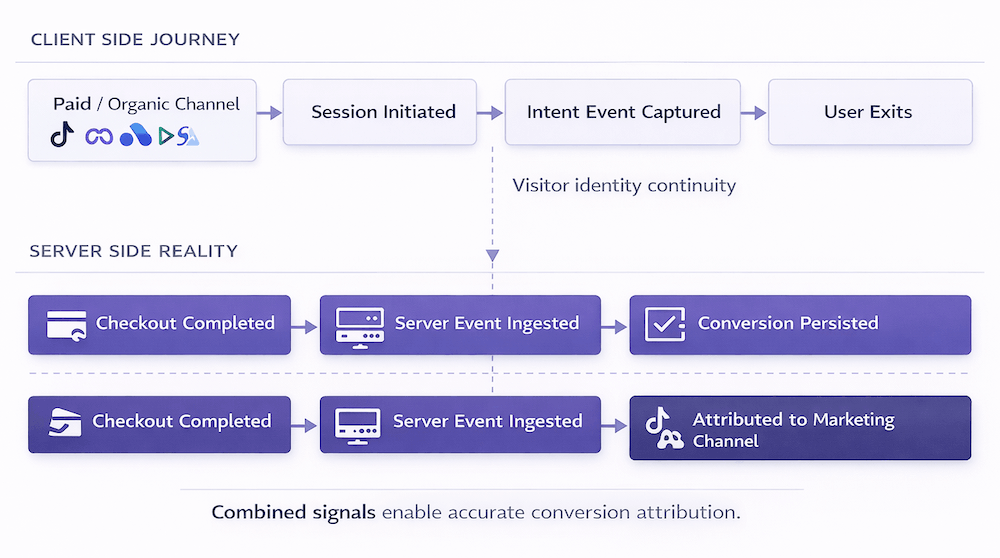
In a hybrid architecture:
- browser tracking establishes the marketing and behavioural context
- server events confirm the outcome and value of that journey
- identity resolution mechanisms link both environments
This approach reduces attribution ambiguity and enables decision-grade growth insights.